
Last updated October 30, 2026
 Metal roofing
 Architectural shingles
 Tile roofing
 GAF
 Owens Corning
 Flat & low-slope
Free roof inspection with deck photos before we talk money - GAF and Owens Corning certified installation
How to Hire a Roofing Contractor in Anaheim: A Step-by-Step Guide
California has one of the strictest contractor licensing regimes in the country, yet the Contractors State License Board still receives thousands of roofing complaints every year. That gap between regulation and real-world outcome tells you something important: a valid license is the floor of qualification, not the ceiling. Most roofing failures in Anaheim don’t come from unlicensed operators. They come from licensed contractors who cut corners on materials, misread California code requirements, or write contracts that protect them more than you. This guide gives you a structured vetting process built around the questions that actually separate qualified roofers from expensive mistakes.
Quick Answer
To hire a roofing contractor in Anaheim, verify their C-39 license status and bond with the CSLB, confirm current manufacturer certifications for the material you plan to install, require a written quote with specific line items (underlayment spec, decking allowance, disposal), and check that the contract includes a payment schedule tied to milestones, lien waiver language, and a defined workmanship warranty. Start with a roof inspection before getting replacement quotes so you know whether repair is even on the table; our Roof Repair Troubleshooting: Common Problems and How to Fix Them can help you spot issues early.
Styles & brands we work with
Table of Contents
- Step 1: Verify the C-39 License, Bond, and Complaint History
- Step 2: Check Manufacturer Certifications Before You Compare Quotes
- Step 3: Understand What Anaheim’s Climate Means for Your Roof
- Step 4: Structure Competing Bids So They’re Actually Comparable
- Step 5: Recognize Anaheim-Specific Red Flags
- Step 6: Review the Contract Line by Line
- Step 7: Ask These Questions Before Signing
Step 1: Verify the C-39 License, Bond, and Complaint History (Under 3 Minutes)
Every roofer in Anaheim must hold a C-39 roofing classification from the California Contractors State License Board. A general contractor’s license (Class B) does not authorize standalone roofing work. If someone shows up with a B license and says they can roof your house, that’s your first red flag. The CSLB requires roofers to carry a $15,000 license bond, and you have a right to verify that bond is active before signing anything.
Here’s the three-minute verification process:
- Go to the CSLB website and use the “Check a License” tool. Enter the license number the contractor gave you. If they hesitate to provide a number, that’s an immediate stop sign.
- Confirm the classification says C-39 Roofing. Not B General Building, not any other class. If the classification doesn’t match the work, the contract is legally suspect from day one.
- Check the license status. It must say “Active.” Anything else, including “Suspended” or “Expired,” means the contractor cannot legally work.
- Review the bond amount and status. The bond exists to protect you if the contractor fails to complete work or violates the contract. An active bond is non-negotiable.
- Look at the complaint history. The CSLB publishes legal actions and arbitration results. One old dispute doesn’t necessarily disqualify anyone, but a pattern of unresolved complaints absolutely should.
We’ve watched Anaheim homeowners discover that a contractor they met at a home show had let their bond lapse six months earlier. They found out only after a dispute arose and there was no financial recourse. Three minutes on the CSLB site would have prevented it.
Step 2: Check Manufacturer Certifications Before You Compare Quotes
Here’s a question most guides skip: does your contractor hold current certifications from the manufacturer of the material you plan to install? It matters more than most homeowners realize because manufacturer warranties are often only valid when a certified installer performs the work.
In our experience, an uncertified contractor can still install a GAF or CertainTeed roof competently. But if a material defect shows up three years later, the manufacturer will ask who installed it. If that name isn’t in their certified contractor database, the warranty claim gets complicated fast. Certifications lapse too. A contractor who was certified by Owens Corning in 2019 and hasn’t renewed isn’t much better than one who was never certified at all.
How to verify:
- Ask the contractor which manufacturers they’re currently certified with, not which they’ve “worked with.”
- Request the certification number or installer ID and confirm it directly on the manufacturer’s website.
- Note the certification tier. Most manufacturers have multiple levels: entry, mid, and top. The higher tiers typically require ongoing training and volume, which signals a contractor who takes material standards seriously.
- Check whether the certification covers the specific material you want. A contractor certified for asphalt shingle installation may not be certified for tile, which matters in Anaheim where Boral concrete and clay tile are common on older homes.
Bedrock Roof Repair works with seven major material brands, including GAF, CertainTeed, Owens Corning, and Boral, which means our recommendations follow the roof’s actual condition and your budget, not a single supplier relationship. When a contractor is locked into one manufacturer’s line, every bid you receive will bend toward that product, whether it suits your home or not.
Step 3: Understand What Anaheim’s Climate Means for Your Roof
Anaheim’s roofing challenges don’t match the rest of the country’s. We get roughly 14 inches of rain a year, concentrated in a handful of storm events between November and March. The real damage comes from the dry season, not the wet one. Sun exposure, UV degradation, and the thermal cycling from 90-degree days to 55-degree nights break down roofing materials slowly, then a single heavy storm exploits every weakened point at once.
What that means for hiring decisions:
- Underlayment matters more than shingle weight in Anaheim. The shingle takes the sun, but the underlayment is what protects your decking when wind-driven rain gets past the shingles. In some Anaheim neighborhoods with larger lots and mature trees, leaf debris and moisture can sit on the roof for extended periods, which accelerates underlayment wear.
- Tile is common in Anaheim’s older neighborhoods, like parts of the Colony Historic District and areas east toward Orange. Tile roofs handle sun well but require specific flashing details and structural assessment. The additional dead load can exceed 10 pounds per square foot versus about 3 pounds for asphalt shingles, which matters on some mid-century wood framing.
- Fire resistance ratings matter. Anaheim sits in a region where wildfire risk and ember exposure are real considerations. Many homes in and around the city fall within designated Fire Hazard Severity Zones. Adjustments to roof covering materials that do not meet Class A fire ratings could affect compliance and insurance availability.
- SoCal building codes are specific. Energy efficiency standards under Title 24, cool roof requirements in certain jurisdictions, and seismic strapping of rooftop equipment all factor into legitimate roof work in Anaheim. A contractor importing practices from Arizona or Nevada may not know these codes exist.
Before any replacement, we recommend a Roof Inspection in Anaheim to document the actual condition of the decking, underlayment, and existing materials. An inspection tells you whether a targeted repair buys you five more years or whether you’re financing a replacement on a roof that needed help two storms ago.
Step 4: Structure Competing Bids So They’re Actually Comparable
There’s a reason two Anaheim roofers can quote $9,000 and $19,000 for what sounds like the same job. The cheaper bid isn’t always hiding something. The expensive one isn’t always padding. More often, they’re quoting different scopes of work, and without a Roofing Cost Breakdown: The Anaheim Homeowner’s Reference for 2026, you can’t tell the difference.
Every legitimate roofing quote in Anaheim should include these line items:
- Underlayment specification. What product, what weight or thickness, what brand. A quote that says “synthetic underlayment” without a manufacturer and product number is incomplete. A quote that doesn’t mention underlayment at all is disqualifying.
- Decking replacement allowance. No one can know how much plywood or OSB needs replacement until the old roof comes off. A good quote includes a per-sheet price for decking replacement, so you know the cost of surprises in advance. A quote that doesn’t address decking will hit you with a change order the moment rotted wood appears.
- Flashing materials and scope. Which flashing gets replaced, and with what material. Valley metal, pipe boots, step flashing, and chimney flashing should all appear as named components. Flashing is where leaks actually happen in Anaheim’s storm season.
- Ventilation. Ridge vents, soffit vents, or static vents and how many of each. Attic temperatures in Anaheim regularly exceed 130 degrees in summer. Ventilation spec directly affects shingle lifespan and your energy bills.
- Disposal and hauling. The old roof goes somewhere. The dumpster costs money. If this line item is absent, it’s buried in overhead or absent from the work plan, either of which creates problems.
- Permit and inspection fees. Roof work in Anaheim requires permits when the scope exceeds repairs. A quote should say whether permits are included and who handles the scheduling.
- Payment schedule. Never a 50 percent deposit upfront. California law caps the down payment for home improvement contracts at $1,000 or 10 percent of the contract price, whichever is less. Any quote demanding more on day one is operating outside the law.
One thing we always tell homeowners: if you’re comparing a repair quote against a replacement quote, you need to know which one is actually warranted. Roof Repair in Anaheim is frequently an option when the decking is sound and the issues are localized to flashing, ridge caps, or a few compromised shingles. A repair-before-replacement evaluation should be the default, not the exception.
Step 5: Recognize Anaheim-Specific Red Flags
This section is going to save some readers real money. Anaheim has two distinct red flag patterns we see repeatedly, and neither one looks like a scam at first glance.
The storm chaser. After any significant wind event or the fire seasons that bring ember exposure concerns, out-of-area crews descend on Anaheim. They’re easy to spot with a few questions. Their license number usually traces to a company address in Texas, Nevada, or Northern California. They never mention the CSLB by name. They’re gone 90 days after the event, and if a problem shows up in month six, the warranty lives wherever they live now. When you call the number, it’s disconnected.
The door-to-door inspection offer. A friendly person knocks and offers a “free roof inspection” because they were “in the neighborhood.” They find storm damage, often by pointing at moss, cracked caulking, or other conditions that are present on most roofs of a certain age. The inspection isn’t a diagnosis; it’s a sales funnel with a script. They’ll tell you insurance will cover the work, then substitute cheap materials for what the insurance payout specified. The free inspection may also violate Anaheim municipal code regarding solicitation permits, depending on your neighborhood.
Step 6: Review the Contract Line by Line
By the time you’re reading a contract, you should have already verified the license and certifications. Now you’re reading for the fine print that determines what happens when things go wrong, because on roofing projects, something eventually will.
Here’s what a legitimate Anaheim roofing contract includes:
- Scope of work in plain language. Every material named with brand and model number. Every surface area listed. Every inclusion and exclusion stated explicitly. “All necessary work” is not a scope.
- Payment schedule structured around milestones. For example: $1,000 down to schedule, 30 percent upon delivery of materials to the site, 30 percent upon substantial completion, remainder upon passing final inspection. You should never pay the full contract amount before the job is done.
- A conditional lien waiver clause. Under California law, subcontractors and material suppliers can place a mechanic’s lien on your property if the general contractor doesn’t pay them, even if you paid the contractor in full. A proper contract includes language requiring the contractor to provide lien waivers from every sub and supplier before you release final payment. This is non-negotiable in Orange County, where mechanics lien filings are common.
- A defined workmanship warranty. Material warranties come from manufacturers. Workmanship warranties come from the contractor. The contract should state exactly what’s covered, for how long, and what voids it. Legitimate workmanship warranties cover installation defects. They do not cover storm damage, foot traffic, or neglect.
- Change order procedure. If decking needs replacement and it exceeds the allowance in the quote, how is that authorized? In writing, with a signed change order, before the work happens. Any contractor willing to do surprise work without a signed change order isn’t doing you a favor.
The payment schedule matters especially in Roof Replacement in Anaheim, where project costs are high and the temptation to collect early is real. If a contractor resists milestone-based payments, that tells you something about their cash flow and their confidence in finishing the job.
Step 7: Ask These Questions Before Signing
Most homeowners never ask these questions because they don’t know they matter. They do, and any established Anaheim roofer will answer all of them without hesitation.
- “What’s your CSLB license number, and may I verify it while we’re standing here?” Watch their face. A contractor who doesn’t know their number by heart is a contractor who doesn’t use it often.
- “Are you certified with the manufacturer of the material you’re recommending? May I see the current certification?” If the answer is a story about how certifications don’t matter, it’s a story, not an answer.
- “What underlayment are you specifying, and why that product for my roof?” This question separates material experts from installers. An installer says “standard synthetic.” An expert names the product and explains the choice.
- “What’s your per-sheet rate for decking replacement?” They should know this off the top of their head. A hesitating answer means either inexperience or a plan to negotiate that number after the old roof is off.
- “Who pulls the permit, and is the fee included?” In Anaheim, roof replacements require permits through the city’s building division. If the contractor suggests skipping the permit to save money, walk away. Unpermitted roofing work can come up in a future home sale and jeopardize the entire deal.
- “Who provides lien waivers, and when?” The answer should be immediate: from every sub and supplier, at final payment. Anything less exposes you to mechanics lien risk under California Civil Code.
Here’s the uncomfortable truth that a lot of guides won’t tell you: there are hundreds of contractors in Orange County who can install a roof. The number who can explain why they chose a specific underlayment for your specific roof orientation, why a GAF product fits your budget better than a CertainTeed product, and how their flashing details account for Anaheim’s particular weather patterns is much smaller. The questions above are how you find them.
Common Mistakes to Avoid
- Getting only one bid. Even a great contractor should be compared against at least one other structured bid. The comparison process itself is educational. With one bid, you’re not hiring; you’re accepting.
- Treating the $1,000 check as a “deposit” beyond its legal meaning. California caps the down payment at the lesser of $1,000 or 10 percent. If a contractor asks for $5,000 down on a $15,000 job, that’s illegal under state law, and you should report it to the CSLB.
- Skipping the permit. In Anaheim, unpermitted roof work is discoverable during title searches and home inspections. You may not care today, but the buyer of your home will, and so will their lender.
- Assuming certification equals competence. A current manufacturer certification is a necessary signal, not a sufficient guarantee. Verify it, then verify the contractor’s local reputation through references, not just review platforms.
- Signing without seeing the decking. If the contractor hasn’t looked under the shingles, they’re guessing about the most expensive surprise in roofing. Insist on a documented decking inspection before signing a replacement contract.
- Accepting “included in labor” as a line item. Disposal, permits, flashing, and ventilation should each appear as their own line. Companies that lump everything into “labor” are giving you less visibility into what you’re actually buying.
- Ignoring the fire rating question. Anaheim is not Paradise or Santa Rosa, but ember exposure is real throughout Orange County. Replacing a roof with a material below Class A fire rating may not only create risk; it may conflict with insurance requirements.
See the difference
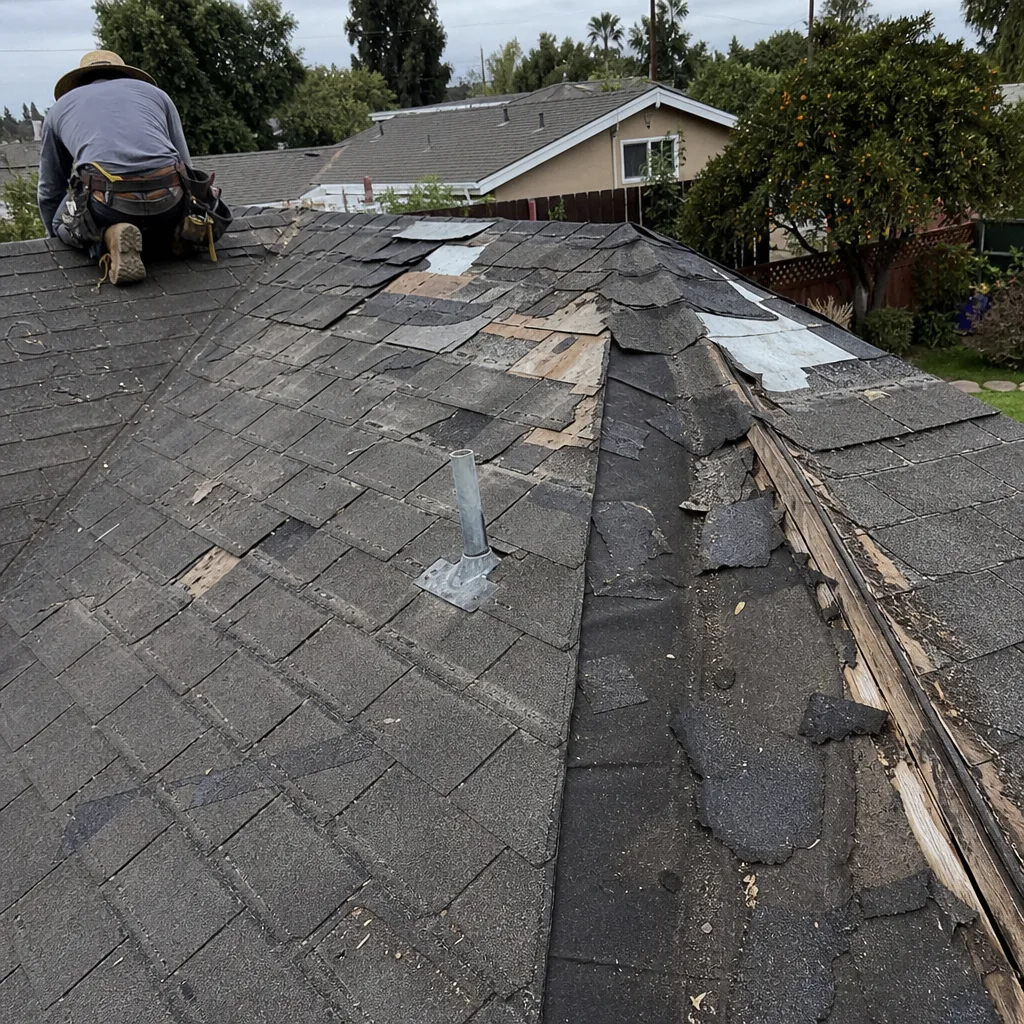 Before
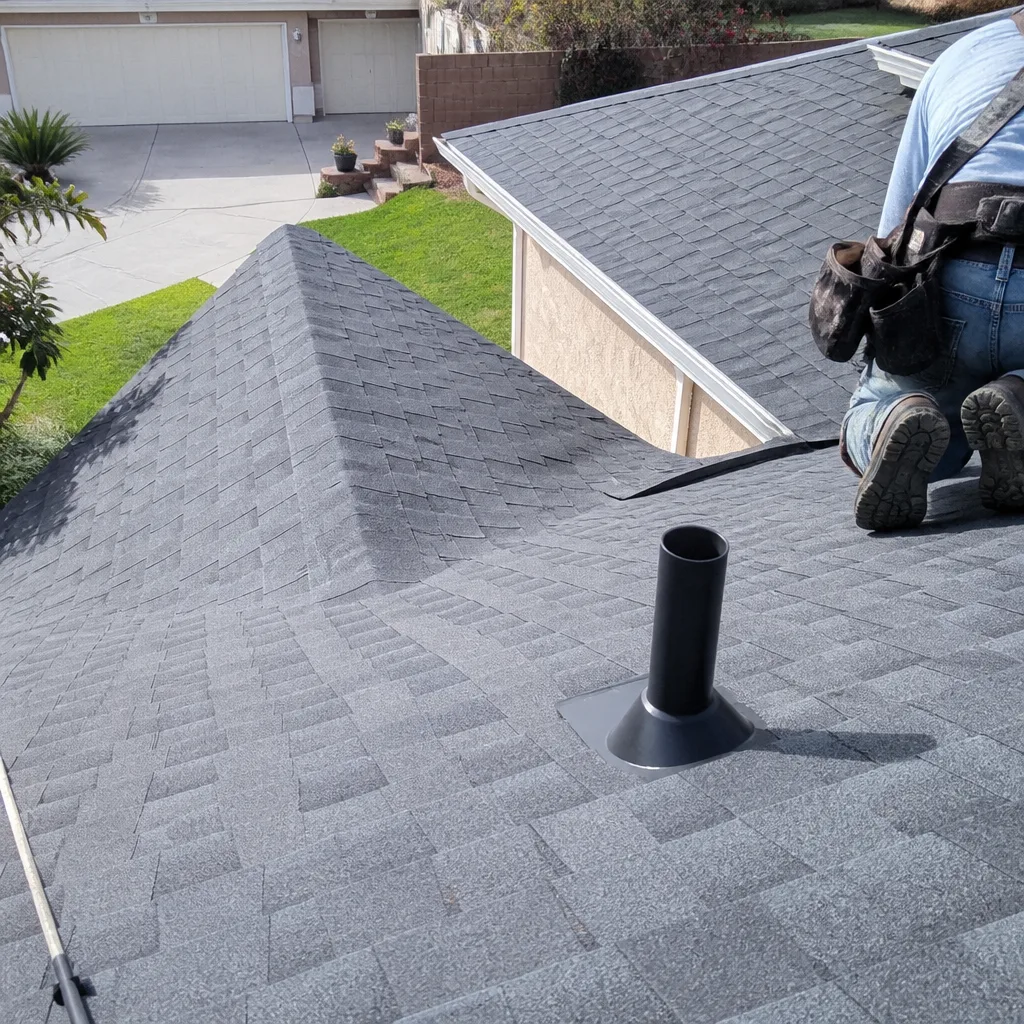 After
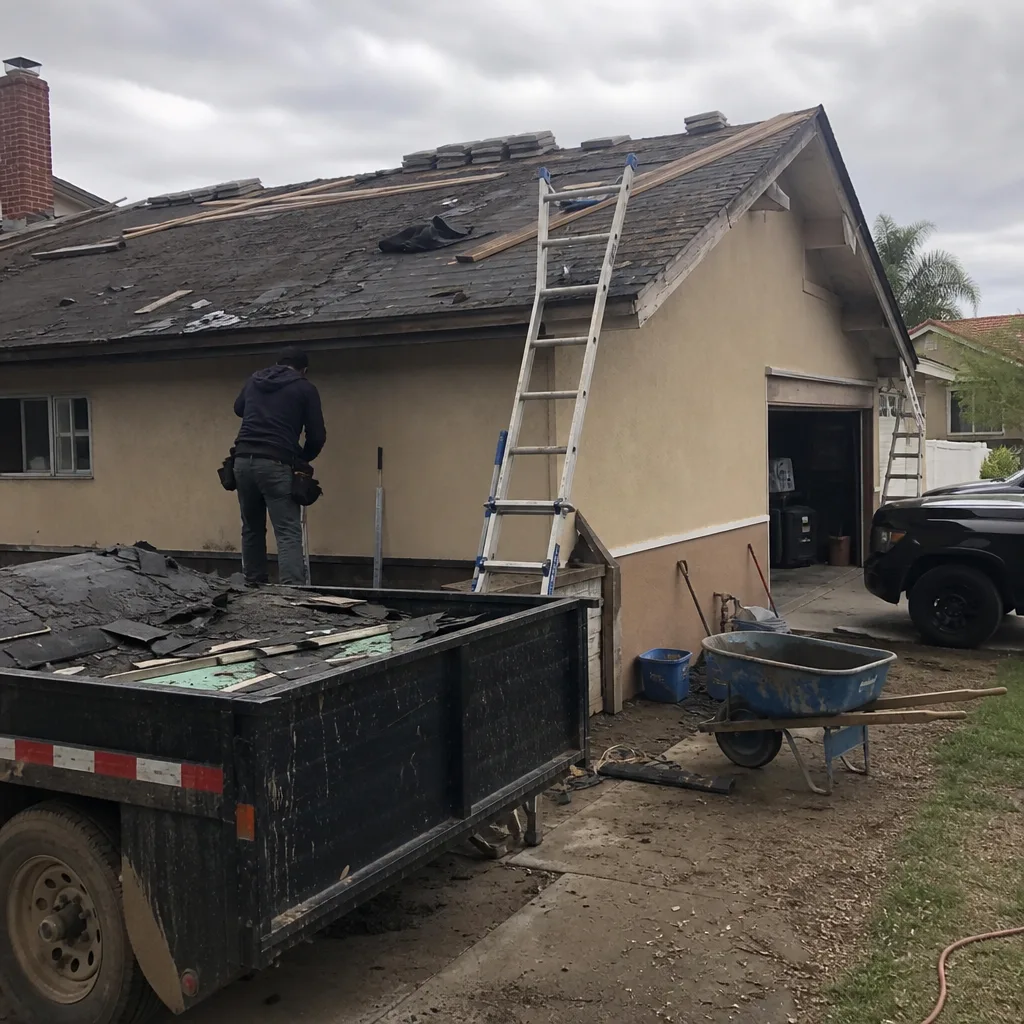 Before
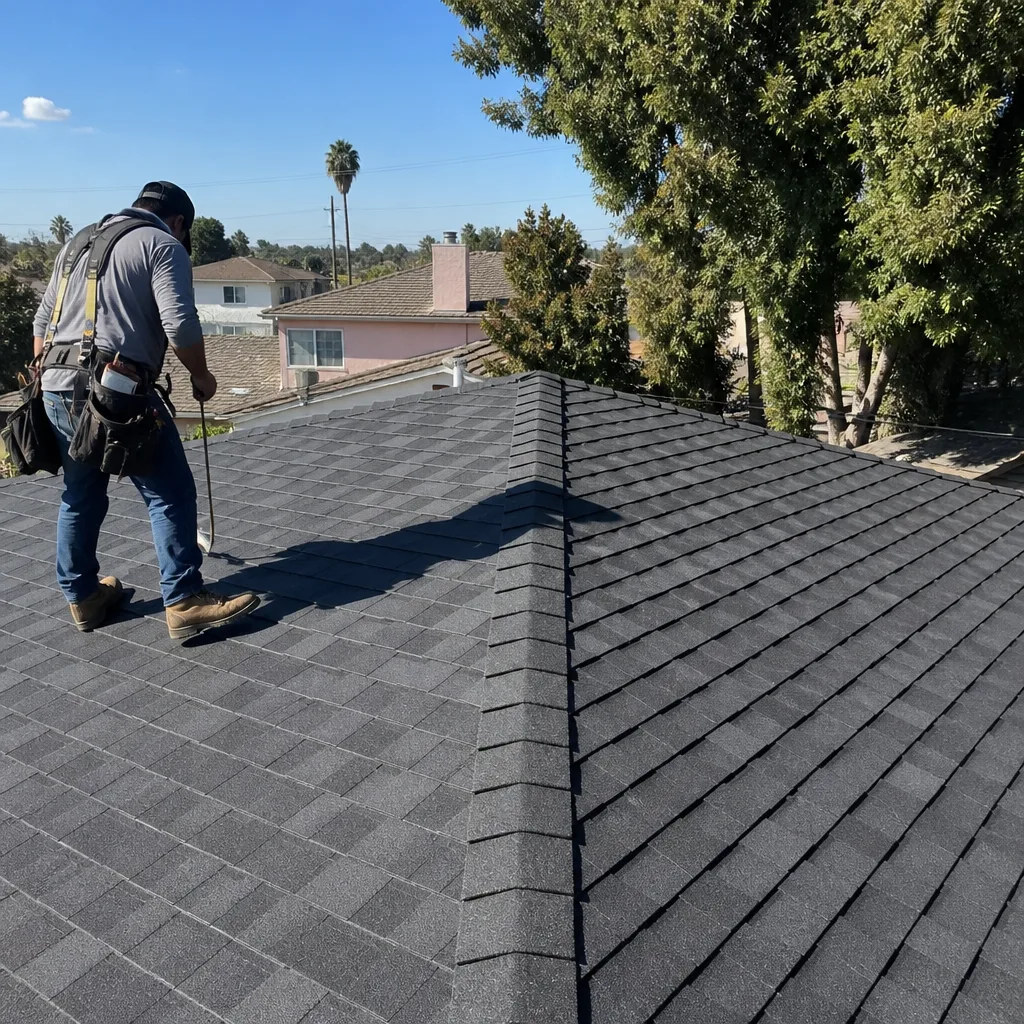 After
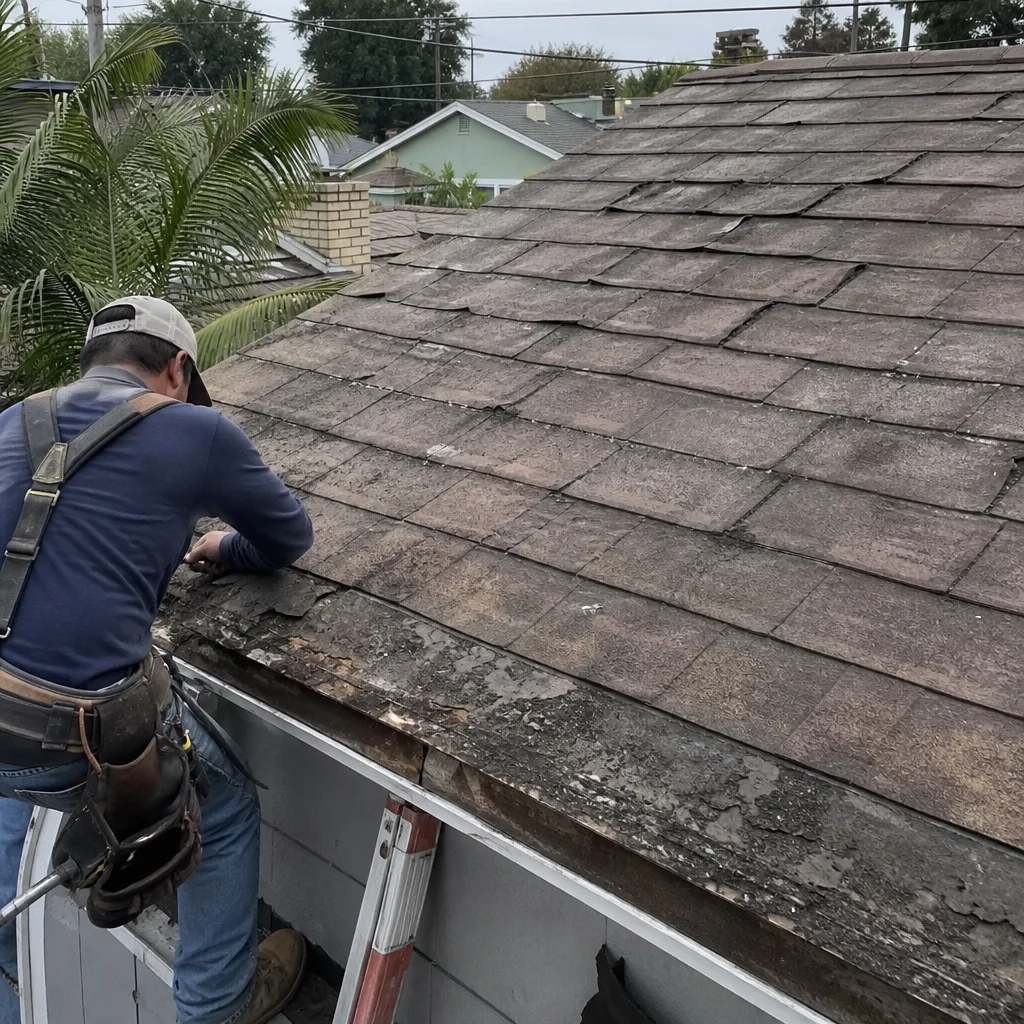 Before
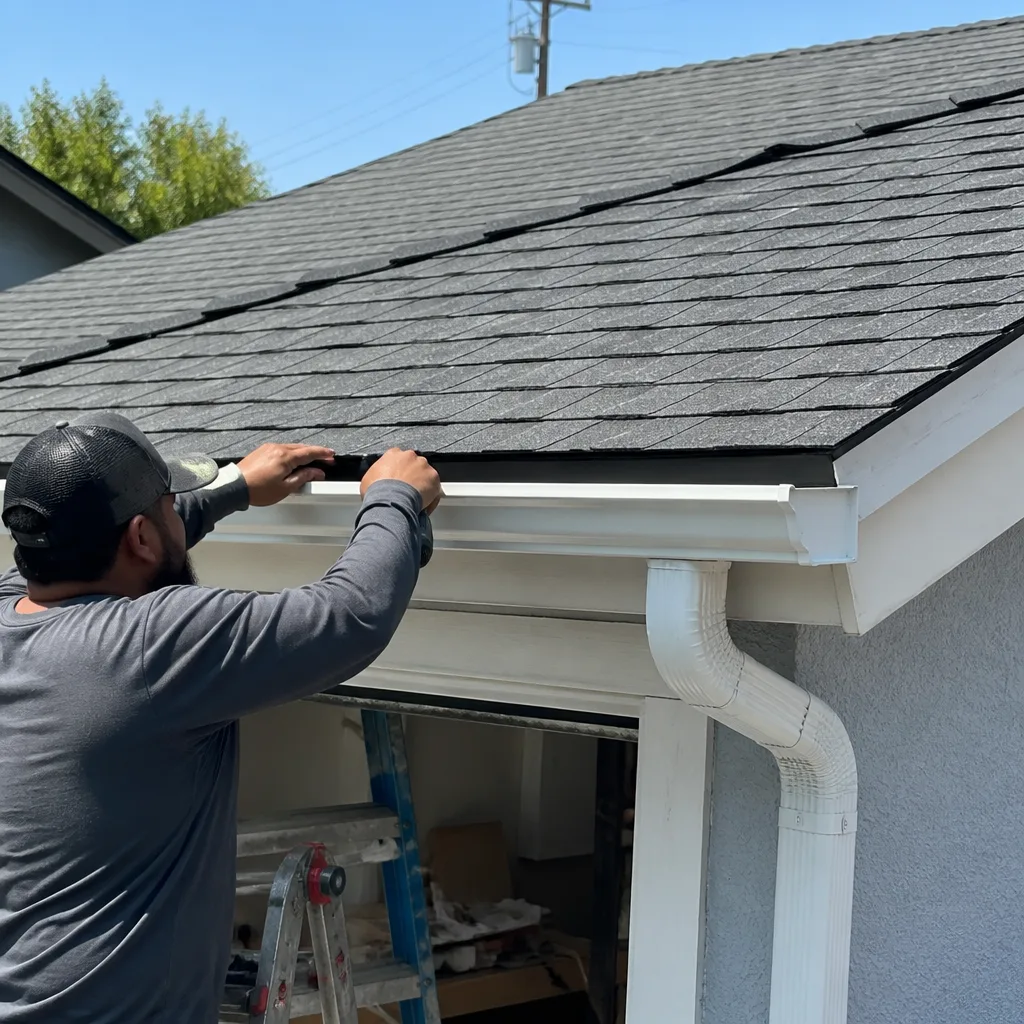 After
When to Call a Professional
A water stain on the ceiling, granules accumulating in gutters, shingles curling at the edges, daylight visible in the attic, or a roof over 15 years old that hasn’t been inspected in three or more years are all thresholds for professional evaluation in Anaheim. You don’t need to know what’s wrong. You need to know whether something’s wrong, and the most efficient way to get that answer is a documentable inspection. If you’re considering buying or selling a home in Anaheim, a roof inspection should be part of your due diligence, not an afterthought in escrow. Bedrock Roof Repair offers free estimates in Anaheim – call (833) 589-7850 to schedule a roof evaluation and get a straight answer on whether your roof needs repair, replacement, or nothing yet. For Roof Repair Maintenance Checklist for Anaheim Homeowners and other guidance, see our blog.
Frequently Asked Questions
Verify the contractor’s C-39 roofing license on the CSLB website using their license number. Confirm the status says “Active,” the bond is current, and the classification is specifically C-39 Roofing, not General Building or another class. The entire check takes under three minutes, and any contractor who refuses to provide their license number is disqualifying themselves.
Roof replacement costs in Anaheim typically range from $9,000 to $25,000 depending on roof size, pitch, material choice, decking condition, and access. In neighborhoods like Anaheim Hills and Anaheim Colony with larger or architecturally complex homes, prices skew higher due to square footage, roof height, and accessibility. A written, line-item quote is the only way to get an accurate number for your specific home. Call (833) 589-7850 to schedule a free estimate with Bedrock Roof Repair in Anaheim.
A C-39 license is the California contractor classification specifically for roofing work, issued by the Contractors State License Board. Only a C-39 holder can legally perform roofing installation, repair, and replacement in Anaheim. A General B license does not cover roofing as a standalone scope, and hiring a B-licensed contractor for roofing work creates liability problems from the first day of the project.
Yes, if the decking beneath the old roof is rotted, water-damaged, or structurally compromised, and that condition was not visible during the initial estimate. A legitimate quote includes a stated per-sheet rate for decking replacement so any price adjustment is predictable and pre-authorized. Any price increase beyond that allowance should require a signed change order before the work proceeds, never after it has already happened.
Most residential roof replacements in Anaheim take between two and five working days depending on roof complexity, pitch, and material. Tile and flat roof systems generally take longer than asphalt shingles due to installation requirements and material handling. The contract should include a start date, a schedule, and a provision for what happens if weather interrupts work, particularly during Anaheim’s winter rain season from November through March.
Yes, roof replacements in Anaheim require permits through the city’s building division, and the project is typically inspected at specified stages. Repair work that does not alter the roof structure or replace significant portions of the roof may not require a permit, but the contractor should confirm the threshold. A contractor who recommends avoiding permits is asking you to accept legal and resale risk that falls entirely on you.
The Bottom Line
Hiring a roofing contractor in Anaheim comes down to verification and structure. Verify the C-39 license and bond. Verify the manufacturer certifications are current. Verify the contract includes specific line items, milestone payments, lien waivers, and a real workmanship warranty. Then compare structured bids instead of headline numbers. The contractor who explains why a specific material suits your specific roof, who documents the decking before quoting, and who treats repair as a legitimate outcome before replacement is proposed is the contractor you want. Browse our more guides & resources for additional help vetting pros. The difference shows up five years later, in a roof that stays dry through another Anaheim winter.
Bedrock Roof Repair works with seven leading material brands, including GAF, CertainTeed, Owens Corning, and Boral, so our recommendations follow your roof’s condition and budget. We’ll tell you what your roof actually needs, repair, replacement, or nothing yet. Call (833) 589-7850 for a free estimate, or visit our Bedrock Roof Repair home to learn more about how we work from inspection to final nail.
Written by the team at Bedrock Roof Repair, serving Anaheim since 2018.